logo
FAMOUS Steel Engineering Company
อ้างอิง
ผลิตภัณฑ์
ผลิตภัณฑ์
บ้าน > ผลิตภัณฑ์ > โครงสร้างเหล็ก > AMERICA STANDARD AASHTO/AWS D1.5M STEEL ARCHED BRIDGE BOX BEAM FABRICATION

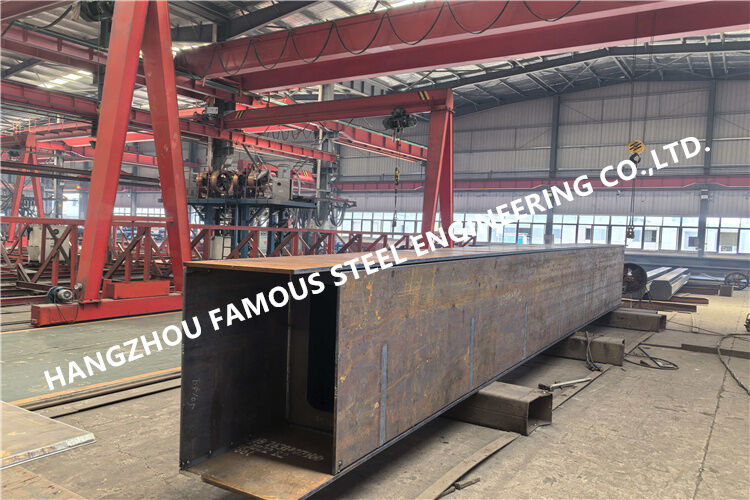
AMERICA STANDARD AASHTO/AWS D1.5M STEEL ARCHED BRIDGE BOX BEAM FABRICATION

รายละเอียดสินค้า

สถานที่กำเนิด: จีน

ชื่อแบรนด์: FASEC

ได้รับการรับรอง: CE, ISO, SGS

หมายเลขรุ่น: เฮิร์ทซ์

เงื่อนไขการชําระเงินและการจัดส่ง

จำนวนสั่งซื้อขั้นต่ำ: 25 ตัน

ราคา: USD1200-2200/ton

รายละเอียดการบรรจุ: บรรจุสมุทรในภาชนะหรือเรือจำนวนมาก

เวลาการส่งมอบ: ตามความต้องการของลูกค้า เช่น 2-3 เดือน

เงื่อนไขการชำระเงิน: l/c, t/t, d/a, d/p

สามารถในการผลิต: 100,000 ตันต่อปี

หา ราคา ที่ ดี ที่สุด
เน้น:
ระดับ:
เหล็ก Q345b
ขนาด:
ทำให้เสียค่าใช้จ่าย
พิมพ์:
เสาเอชบีม
แอปพลิเคชัน:
อาคารที่อยู่อาศัย
การรักษาพื้นผิว:
สังกะสี
สถานที่กำเนิด:
หางโจว
ระดับ:
เหล็ก Q345b
ขนาด:
ทำให้เสียค่าใช้จ่าย
พิมพ์:
เสาเอชบีม
แอปพลิเคชัน:
อาคารที่อยู่อาศัย
การรักษาพื้นผิว:
สังกะสี
สถานที่กำเนิด:
หางโจว
AMERICA STANDARD AASHTO/AWS D1.5M STEEL ARCHED BRIDGE BOX BEAM FABRICATION

AMERICA STANDARD AASHTO/AWS D1.5M STEEL ARCHED BRIDGE BOX BEAM FABRICATION


Steel box girder bridges have evolved into one of the most dominant superstructure forms for medium-to-long-span highway and railway infrastructure across North America and global engineering projects adopting American design specifications, with AASHTO/AWS D1.5M Bridge Welding Code functioning as the core mandatory technical standard governing all shop prefabrication and field welding works of such bridge structures. Jointly formulated and updated by the American Welding Society (AWS) and American Association of State Highway and Transportation Officials (AASHTO), the latest 2025 ninth-edition D1.5M code is specially customized for carbon and low-alloy structural bridge steels, distinguished from general structural welding specification AWS D1.1 by stricter fatigue resistance, fracture control and nondestructive testing rules targeting bridge cyclic vehicle loads and long-term environmental erosion . Steel box girders rely entirely on full penetration groove welds and fillet welded stiffener systems to form closed hollow cross-sections; hence every fabrication link from base steel incoming inspection to finished weld acceptance is strictly bounded by D1.5M clauses, which directly determines structural safety, service durability and anti-fatigue performance of the whole bridge spanning decades of operation. This paper elaborates structural configuration of standard steel box girder bridges, core specification framework of AWS D1.5M, classified welding control between fracture-critical and non-fracture-critical components, fabrication execution norms and practical engineering application value of the standard system.

1. Structural Composition and Mechanical Advantages of Standard Steel Box Girder Bridge

A typical orthotropic steel deck box girder consists of five core welded components: top orthotropic deck plate, vertical web plate, bottom tension flange plate, longitudinal closed/open stiffeners welded on inner plate surfaces and transverse intermediate diaphragms spaced along the bridge longitudinal direction. Conventional main plate thickness ranges from 12 mm to 32 mm, while secondary stiffener and diaphragm plates adopt 10 mm–20 mm rolled steel plates; all discrete segments with factory prefabricated lengths of 10–30 meters are transported to construction sites for final splice field welding as full-span continuous girders. Compared with traditional I-shaped plate girders, the closed-box cross-section features outstanding torsional rigidity and lateral load distribution capacity, effectively resisting eccentric live loads from highway trucks and high-speed train dynamic impacts, reducing overall steel consumption by nearly 15%–22% under identical span and load design parameters.

Base materials applied for American-standard box girders mainly follow AASHTO M270 (equivalent to ASTM A709) series structural steel grades, including Grade 345 (A709 Gr50), HPS485W high-performance weathering steel and Grade 690 high-strength low-alloy steel, all covered within D1.5M applicable scope (yield strength ≤690 MPa). The top orthotropic deck’s closed U-shaped longitudinal ribs are continuously fillet-welded beneath deck plates, forming integrated orthotropic pavement bearing system which disperses concentrated wheel loads uniformly to box girder webs and bottom flanges; these dense rib-to-plate welded joints are the most fatigue-prone positions of box girders and become key inspection objects regulated by D1.5M anti-fatigue weld tolerance requirements. Diaphragm plates cross through cutouts reserved on longitudinal stiffeners and are fully welded with inner box walls to restrain section distortion under lateral wind load and asymmetric vehicle loading, whose fillet weld sizes, preheat and defect acceptance criteria are clearly defined in Clause 6 and Clause 8 of D1.5M standard.

2. Core Regulatory Framework of AWS D1.5M for Box Girder Welding

Different from universal construction welding standards, D1.5M is compiled specifically for bridge service environment featuring repeated alternating loads, temperature fluctuation and outdoor corrosive atmosphere, with total 12 formal clauses in current 2025 version, among which Clauses 1–11 set general welding requirements for non-fracture-critical members (NFCM), and exclusive Clause 12 establishes stringent fracture control specifications for Fracture-Critical Members (FCM), the most pivotal provision for box girder tension flange and main splice weld control . The standard is compiled in dual-unit format (metric D1.5M and imperial D1.5), satisfying international metric fabrication and American customary dimension measurement simultaneously .

The core classification principle of D1.5M lies in separating FCM and NFCM for differentiated technical control: FCM refers to box girder bottom tension flange, full-penetration longitudinal splice groove welds of webs and orthotropic deck main splices, whose sudden brittle fracture under service loads would trigger overall partial or full bridge collapse without redundant load transfer path, such as two-box single-cell girder main tension components. All FCM welds enforce three mandatory rules in Clause12: customized preheat/interpass temperature tables independent from NFCM, Charpy V-notch (CVN) low-temperature impact toughness test for deposited weld metal and heat-affected zone, plus enhanced full-coverage ultrasonic testing (UT) nondestructive examination (NDE) executed by Level II certified inspectors. In contrast, multi-cell box girders with three or more parallel box chambers own redundant force-bearing paths and most inner stiffener and diaphragm welds are categorized as NFCM, adopting general preheat tables and conventional visual inspection plus partial spot NDE per Clause 6 of D1.5M.

Welding Procedure Specification (WPS) and Procedure Qualification Record (PQR) approval is the primary precondition before box girder batch fabrication regulated by D1.5M Clause 3; all applied welding processes including submerged arc welding (SAW) for long straight flange groove welds, flux-cored arc welding (FCAW) for stiffener fillet welds and shielded metal arc welding (SMAW) for field splice repair must complete PQR qualification according to standard test specimen requirements before formal production. Tack welds for component assembly also comply with D1.5M tack welding specifications: temporary tack welds to be fully remelted during subsequent continuous welding can waive strict preheat, while reserved permanent tack welds need identical preheat and quality standards matching final finished welds .

3. Detailed Welding Quality Control and Defect Tolerance for Box Girder per D1.5M

Weld geometric imperfection tolerance updated in D1.5M:2025 directly targets typical box girder weld defects including undercut, incomplete penetration and porosity, with three-tier classified undercut limit newly optimized replacing former dual-standard regulation . For groove welds on box girder tension flange and web tension zone (weld transverse to primary tensile stress), allowable maximum undercut depth is limited to 0.01 inch (0.254 mm), the strictest tolerance to prevent fatigue crack initiation from stress concentration at undercut notches; stiffener corner fillet weld undercut allows up to 1/8 inch depth, and ordinary non-stressed auxiliary connection welds apply 1/16 inch undercut threshold, effectively guiding factory inspectors’ on-site acceptance judgment for massive stiffener welds on box inner space .

Preheat and interpass temperature control is another vital D1.5M regulatory item for thick-plate box girder fabrication to avoid hydrogen-induced cold cracking. Minimum preheat value is determined by base steel grade, plate thickness and ambient environment temperature via standard attached tables: for A709 Gr50 plate thicker than 38 mm used for box bottom flange, NFCM preheat starts at 70°F (21℃), while corresponding FCM preheat rises to over 150°F (65℃) under identical thickness per Clause12 special tables; interpass upper temperature is capped to control welding heat input and refine weld grain structure for improving low-temperature toughness, especially critical for winter open-air field splice welding of box girders .

Nondestructive testing scope differs sharply by member category under D1.5M: all full-penetration FCM groove welds of box girder main splices require 100% UT scanning after welding cooling down to ambient temperature, with rejection criteria stricter than D1.1; NFCM fillet welds connecting diaphragms and inner stiffeners adopt periodic sampling UT inspection plus full visual check, only surface crack indication triggers supplementary liquid penetrant testing (PT). Unqualified defective welds must formulate formal repair WPS and complete re-welding after removing flaw region fully by grinding or gouging, with repaired FCM welds repeating full NDE retest as original production weld per standard repair clauses .

4. Engineering Application and Industry Significance of D1.5M Standard for Box Girder Bridges

Since D1.5M became compulsory reference specification of AASHTO LRFD Bridge Design Manual, over 70% of medium-and-long-span steel box girder highway bridges in North America adopt this standard for full-cycle welding management, extending to overseas international bidding projects in Southeast Asia, Middle East and Africa following American design codes. Standardized D1.5M execution unifies fabrication judgment criteria among designers, steel fabricators, third-party inspectors and construction contractors, eliminating inconsistent technical requirements caused by scattered regional departmental specifications before unified AWS-AASHTO standard release in 1970s.

From economic and durability perspective, standardized D1.5M anti-fatigue weld control effectively reduces early-stage fatigue crack maintenance cost of orthotropic steel deck box girders; proper preheat and fracture toughness specifications cut cold cracking repair rate during thick-plate fabrication by more than 60%, lowering overall construction period and project cost for prefabricated box girder segments. With gradual popularization of high-performance HPS weathering steel box girders in modern bridge engineering, D1.5M continues updating corresponding welding parameter clauses in every new edition to match novel steel material development, maintaining its core dominant position in American and global American-spec steel box girder bridge welding industry .

Conclusion

Steel box girder bridge’s inherent closed-section welded structural feature decides the indispensable guiding role of AWS D1.5M standard in its whole fabrication lifecycle. The standard’s unique FCM/NFCM classified management system, targeted preheat rules, graded defect tolerance and tiered NDE scheme are developed precisely responding to box girder’s fatigue and fracture risk characteristics under long-term alternating vehicle load. Continuous revision and technical optimization of D1.5M keep pace with advanced high-performance bridge steel and innovative welding technology progress, becoming fundamental technical guarantee for long-service-life, high-safety American-standard steel box girder bridge construction, and also supplying mature reference specification system for global steel box girder bridge engineering practicing American highway design norms.


AMERICA STANDARD AASHTO/AWS D1.5M STEEL ARCHED BRIDGE BOX BEAM FABRICATION 0

ผลิตภัณฑ์คล้ายกัน